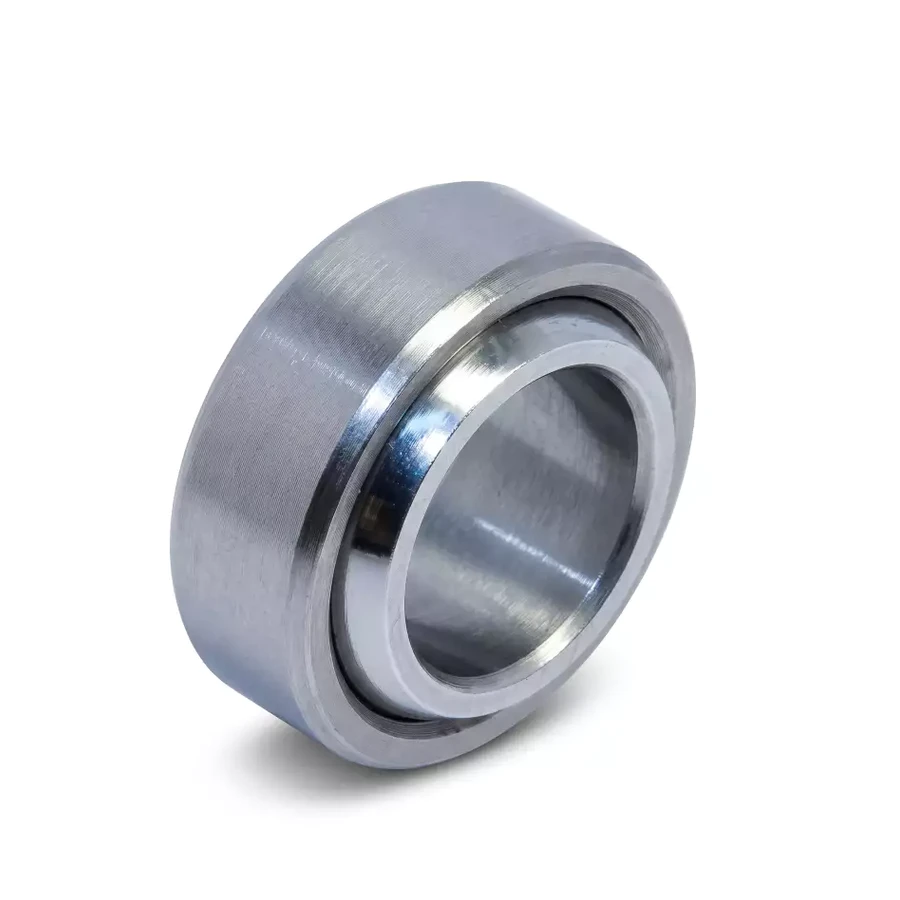
GE and GEG spherical plain bearings can share the same nominal bore, but they do not occupy the same space in the machine. The GEG family uses a wider and larger radial envelope, which is why the right choice starts with the joint geometry rather than the bore code alone.
GE series overview
The GE..E / GE..ES family is the compact standard radial route. In the current range, bore sizes run from 6 to 160 mm. It is suited to pivoting and oscillating joints where a conventional greaseable steel/steel sliding pair and a compact housing envelope are appropriate.
GEG series overview
The GEG..E / GEG..ES family uses a wider section and larger outside diameter for the same nominal bore. The current range runs from 6 to 120 mm. That extra section is important in heavy-duty linkages, but it also changes bracket width, housing diameter and shoulder geometry.
GE20ES vs GEG20ES
| Parameter | EP-GE20ES | EP-GEG20ES |
|---|---|---|
| Bore d | 20 mm | 20 mm |
| Outside diameter D | 35 mm | 42 mm |
| Width B | 16 mm | 25 mm |
| Inner-ring width C | 12 mm | 16 mm |
| Dynamic load Cr | 30 kN | 48.0 kN |
| Static load C0r | 146 kN | 240 kN |
| Articulation alpha | 9 deg | 17 deg |
| Weight | 61 g | 150 g |
At 20 mm bore, EP-GEG20ES has a 240 kN static rating versus 146 kN for EP-GE20ES, about 64% higher in this specific size. That comparison does not mean every GEG/GE pair follows one fixed percentage; check the exact model row you are considering.
When GE is usually the better starting point
- The housing and bracket have limited radial or axial space.
- The application uses moderate loads and a standard serviceable pivot arrangement.
- Existing equipment is already built around the compact GE envelope.
When GEG deserves a closer look
- The joint has more available section width and a heavier load path.
- Hydraulic, construction or mining equipment produces high static or shock loading.
- A wider bearing envelope fits the bracket and pin design without compromising surrounding structure.
Sealed options
Both families are available in 2RS sealed variants in the current range. Two-side lip seals can help at exposed bearing faces, but they do not remove the need to inspect the complete contamination path and grease route in a serviceable steel/steel joint.
The envelope difference changes the surrounding structure
The 20 mm comparison shows why GE and GEG cannot be swapped by bore alone. EP-GE20ES uses D 35 mm and B 16 mm, while EP-GEG20ES uses D 42 mm and B 25 mm. A bracket designed for the compact GE bearing may not have enough radial wall thickness or axial space for GEG. Conversely, a housing designed around GEG may use shoulders or spacers that do not correctly locate a narrower GE bearing.
Static rating is only one part of heavy-duty selection
GEG often provides a higher static rating at the same bore, but the machine still has to deliver the load through the pin and bearing without excessive pin bending, housing distortion or edge loading. In hydraulic and construction equipment, the clevis plates and pin support can be as important as the bearing rating. A larger bearing does not fix a flexible bracket automatically.
Replacement workflow for an unknown GE/GEG joint
- Read the complete old marking and note any 2RS or maintenance-free suffix.
- Measure d, D, B and C before assuming the family from bore size.
- Check the pin for taper, fretting or wear that may change the measured fit.
- Compare load ratings only after the physical envelope has been matched.
- Confirm grease access and seal condition before choosing open or sealed construction.
Need help choosing GE or GEG?
Send the pin diameter, housing envelope, load direction and available bracket width. The series choice can then be checked against the real joint.