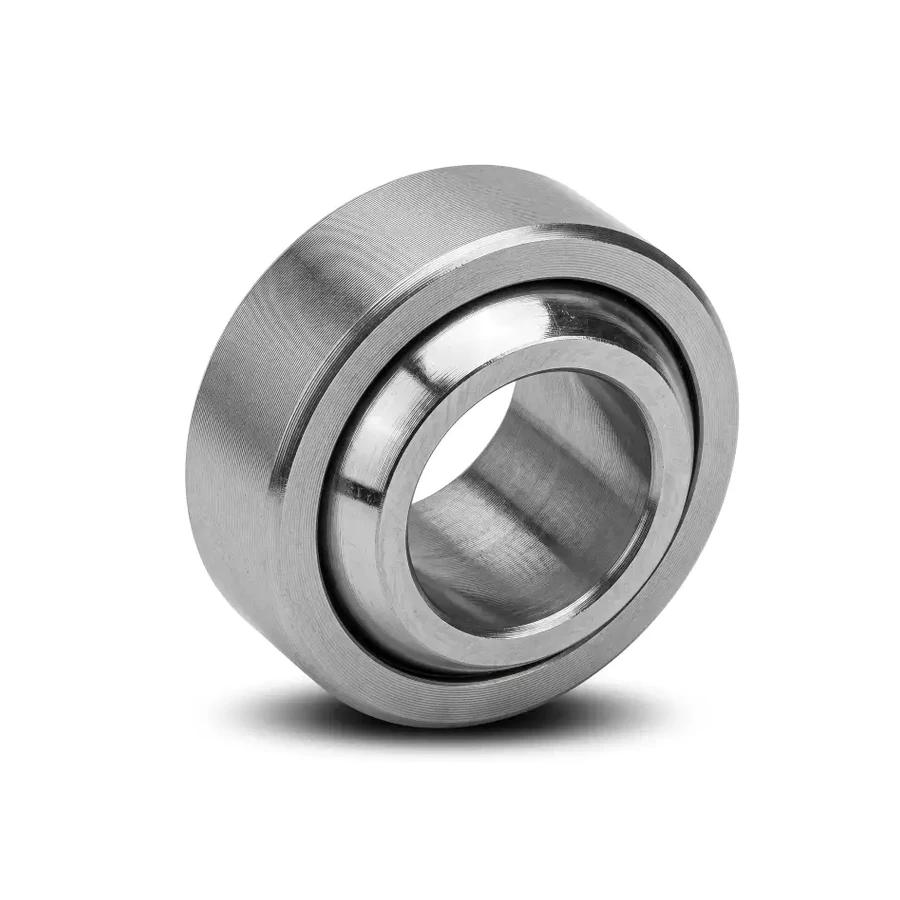
Spherical plain bearings and ball bearings can both support radial load, but they are built for very different motion. The deciding question is whether the joint needs broad sliding contact and articulation, or low-friction rolling contact for continuous shaft rotation.
Sliding contact vs rolling contact
A spherical plain bearing carries load through a spherical sliding interface. A ball bearing carries load through rolling elements between raceways. The sliding design tolerates articulation and is comfortable in slow, reversing pivot motion; the rolling design is the natural starting point for sustained rotation and low running friction.
Misalignment and articulation
A spherical plain bearing is intentionally built to let the inner ring articulate relative to the outer ring. A rolling bearing may have self-aligning designs, but the alignment mechanism and speed capability are different. If the application is actually a rotating shaft that needs rolling contact, compare the appropriate the appropriate self-aligning ball bearing design rather than forcing a plain-bearing solution into a rotating duty.
Load and shock behavior
Spherical plain bearings spread load over a sliding surface and are widely used in low-speed high-load pivots. Ball bearings concentrate load through rolling contacts and can run efficiently at much higher rotational speed. Neither category is universally stronger; the correct bearing follows the machine motion, rating system and interface.
Speed is the clearest dividing line
Continuous high-speed rotation usually points toward a rolling bearing. Slow oscillation, reversing pivots and large angular movement usually point toward a spherical plain bearing. If an application combines rotation and articulation, the joint may need a different bearing architecture or multiple components.
Quick comparison
| Decision | Spherical plain bearing | Ball / self-aligning ball bearing |
|---|---|---|
| Primary contact | Sliding spherical surface | Rolling elements and raceways |
| Typical motion | Oscillation / articulation | Continuous rotation |
| Misalignment approach | Articulation within spherical interface | Self-alignment through rolling-bearing race geometry in applicable designs |
| Maintenance | Greaseable or maintenance-free liner, depending on series | Lubrication system depends on rolling-bearing design |
| Best machine question | Is this a loaded pivot joint? | Is this a rotating shaft? |
Practical decision guide
If the machine has a pin through a linkage and the parts move through an angle, start with spherical plain bearing logic. If the machine has a rotating shaft and the bearing must support speed with low friction, start with rolling-bearing logic. When replacing an unknown part, identify the internal construction before comparing model numbers.
What about self-aligning ball bearings?
A self-aligning ball bearing can accommodate shaft misalignment while still operating as a rolling bearing. That does not make it the rolling equivalent of a spherical plain bearing in a clevis. The self-aligning ball bearing still expects a rotating shaft and rolling raceways. The spherical plain bearing expects a pivoting joint and sliding spherical contact. The word self-aligning describes a capability, not the same mechanism.
Application examples
- Hydraulic cylinder clevis: spherical plain bearing because the connection pivots under high load.
- Conveyor or fan shaft: rolling bearing because the shaft rotates continuously.
- Adjustable linkage with a threaded rod end: spherical bearing insert inside a rod-end housing.
- Long rotating shaft with alignment error: a self-aligning rolling bearing may be appropriate, subject to speed/load design.
Replacement warning
Some machines contain both product types close to each other. A linkage pin may use a spherical plain bearing while the pump or motor shaft nearby uses a ball bearing. Do not search the machine name and assume every bearing serves the same motion. Identify the specific joint before choosing the category.
Selection data that separates the categories quickly
- Is the member rotating continuously or only articulating?
- What angular movement is required?
- Is there a pin and clevis or a shaft and housing?
- What speed is present?
- What static/shock load occurs?
- What lubrication and maintenance system is already built into the machine?
Need the joint type identified?
Send the old marking, dimensions and a photo. We can separate a spherical plain bearing application from a rolling-bearing application before quotation.