Application
Spherical Plain Bearings for Hydraulic Cylinders
High-force cylinder eyes and linkage pins need a bearing choice that balances joint width, articulation, contamination control and the planned lubrication route.

Application Overview
What changes the bearing decision
Hydraulic cylinders use spherical plain bearings at clevis mounts, base eyes, rod-end eyes and articulated linkage points where high force must pass through a pin joint that also needs angular movement. The bearing is not working in isolation: pin stiffness, eye width, bracket deflection and the direction of the cylinder force all influence how the load reaches the spherical contact.
Selection therefore starts with the joint envelope and duty rather than the bore alone. Heavy static load, repeated shock, small oscillation angles, dirt or water, seal exposure and the ability to deliver grease all change the preferred construction. A sealed bearing may help control contamination, while a maintenance-free liner can be useful where service access is poor. The final choice still needs the actual d / D / B / C dimensions and the application conditions.

Key Application Points
Where spherical plain bearings are used
Clevis or base-eye mount
High radial force and bracket deflection can justify the wider GEG envelope. For exposed joints, compare GEG..ES 2RS with the open GEG family.
Rod-end eye / linkage connection
Compact joints often start with GE..ES or GE..ES 2RS; rod-end families can also be relevant when the threaded housing is part of the assembly.
Remote or difficult-to-service cylinder
Where planned relubrication is not practical, GE..C / GEG..C or GE..ET 2RS can be considered after checking load, motion and temperature.
Recommended Products
EVER POWER series to compare first
Primary route for heavily loaded cylinder eyes exposed to dust, mud or water where a wider sealed joint can be accommodated.
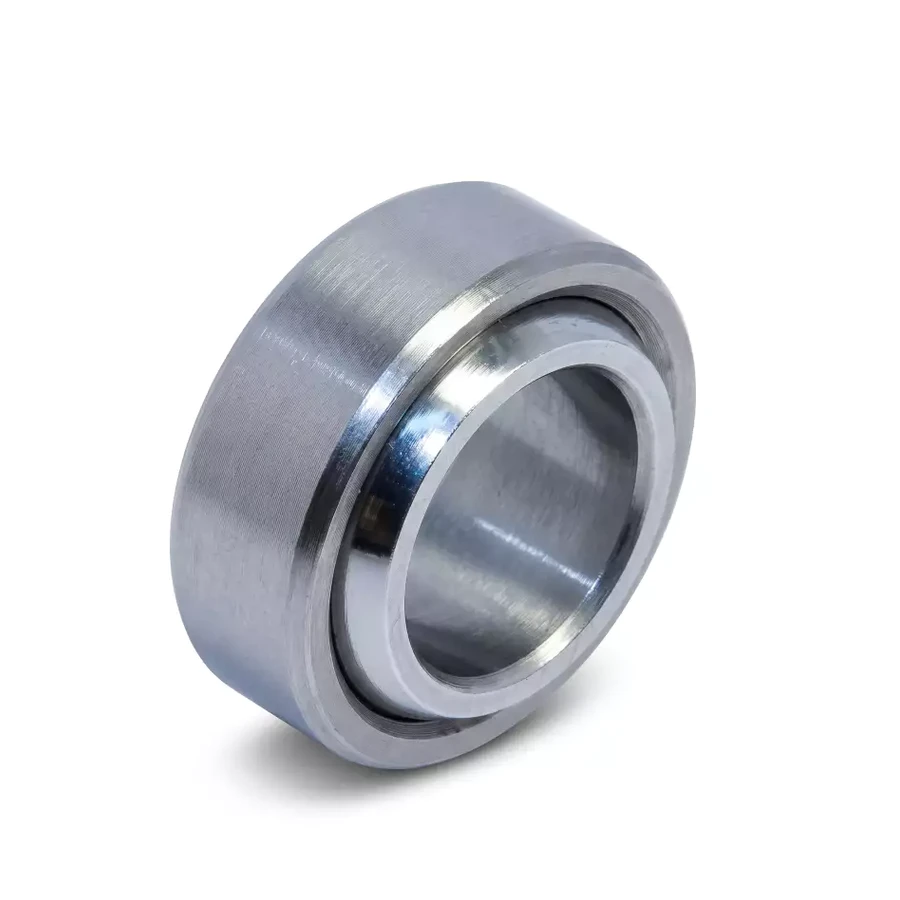
Useful for protected high-load joints with reliable grease access and enough housing width for the heavier GEG envelope.

Compact sealed alternative when the GE envelope suits the eye and the joint still has a planned lubrication route.
Selection Guide
Inputs that matter before model selection
Load and shock
Use the actual cylinder force and load direction to compare the selected model load data; do not infer capacity from bore size alone.
Bore and envelope
Confirm pin diameter, housing bore, overall bearing width and inner-ring width before choosing between GE and wider GEG families.
Articulation
Record the angular movement and whether the joint oscillates around a narrow zone or changes direction under load.
Sealing and maintenance
Describe dust, water or wash-down exposure and confirm whether grease can reach the sliding interface throughout service.
Technical Challenges
Common problems and the practical selection response
High static load or impact
A wider GEG construction can be the stronger starting route when the housing allows it, but pin bending and bracket stiffness still need review.
Mud, water and abrasive contamination
A 2RS version can help protect the bearing faces; surrounding seals, pin condition and purge path remain part of the joint design.
Maintenance access is limited
Maintenance-free PTFE-lined families can remove routine relubrication, subject to the actual load, motion and environment.
Related Technical Articles
Continue the selection work
Spherical Plain Bearings for Hydraulic Cylinders
Joint locations, load path and replacement checks for cylinder eyes and linkage pins.
GE vs GEG Spherical Plain Bearings
Compare the compact GE envelope with the wider heavy-duty GEG family.
Fitting Tolerances: Reading H and g/h Classes
Use the fit tables as a class reference before defining the final housing and shaft fit.
Discuss your hydraulic cylinder bearing requirements
Send the current bearing marking, d / D / B / C dimensions, joint location, motion, contamination, maintenance access and any drawing or document requirement.