Product Description
Spherical roller bearings have 2 rows of symmetrical rollers, a common sphered outer ring raceway and two
inner ring raceways inclined at an angle to the bearing axis. The centre point of the sphere in the outer ring
raceway is at the bearing axis.
Other Designs and Variants Type
1.Double row spherical roller bearings
*Most widely used.
2.Single row spherical roller bearings
*Radial load and compensation misalignment
3.Split spherical roller bearings
*Carrying out replacement work quickly and easily
4.Sealed spherical roller bearings
*Harsh environment applications
5.Spherical roller bearings for vibratory machinery
*Vibration machinery application
6.Extended Inner Ring spherical roller bearings
*Special application
| Product Name | Spherical Roller Bearing |
| Bearing Type | Spherical Roller Bearing |
| Material | GCr15,GCr15SiMn,GCr18Mo |
| Hardness | 58-64HRC |
| Stock Status | Rich stock, guarantee quick delivery |
| MOQ | 1PCS |
| OEM | Acceptable |
| Number of Row | single/double/multi row |
| Special Customization | Acceptable |
| Packaging | Industrial packing; |
| Neutral single box without any brand; | |
| Customer’s special request is accepted; |
Company Profile
In order to meet the needs of the masses of customers and improve the market competitiveness of our company,
we can provide OEM service according to our customers′ Needs. We have gained ISO9001 certificate, CE certificate,
GOST certificate and SGS certificate. Our target is to carry out the strategic investment along with the development
of market and need of new products. With our strategic, excellent products, top technology and outstanding service,
we sincerely expect cooperation with more customers and friends for a better future. Our main products include
spherical roller bearing, deep groove ball bearings, cylindrical roller bearings, spherical roller bearings, needle roller
bearings, ball bearing units, water pump bearings, automobile bearing, linear motion bearing, oil-less bearings,
bush and self-lubricating bearings, and non-standard bearings. Also, we supply bearings to our domestic peeling
machine factory and the machine exported to India, Malaysia and Russia, no any complaint from customer until now.
“zero defect, zero complaints” as the quality objective.
FAQ
Q: Are you trading company or manufacturer ?
A: We are a trading company specializing in exporting bearings.
Q: How long is your delivery time?
A: Generally it is 5-10 days if the goods are in stock. or it is 15-20 days if the
goods are not in stock, it is according to quantity.
Q: Do you provide samples ? is it free or extra ?
A: Yes, we could offer the sample for free charge
Q.You provide free consultation service?
Yes, before, during and after order, anytime.
| Product Name: | Spherical Roller Bearing |
|---|---|
| Characteristic: | High Precision |
| Advantage: | Large Bearing Capacity |
| Holder: | Copper and Iron Retainers |
| Quality: | High Quality |
| Rolling Body: | Roller Bearings |
| Samples: |
US$ 5/Piece
1 Piece(Min.Order) | |
|---|
| Customization: |
Available
| Customized Request |
|---|
Can you provide guidance on the selection and sizing of self-aligning bearings for specific applications?
Yes, here’s a detailed explanation on the selection and sizing of self-aligning bearings for specific applications:
- Understand the Application Requirements:
The first step in selecting and sizing self-aligning bearings is to thoroughly understand the requirements of the application. Consider factors such as:
- Load: Determine the magnitude and direction of the load the bearing will be subjected to, including static, dynamic, and shock loads.
- Speed: Identify the rotational speed or frequency of operation to ensure the selected bearing can handle the required speed without compromising performance.
- Environment: Consider the operating environment, including temperature range, presence of contaminants, moisture, or corrosive substances, and any other specific environmental factors that may affect the bearing’s performance.
- Mounting and Space Constraints: Evaluate the available space for bearing installation and any specific mounting requirements or constraints within the application.
- Service Life and Maintenance: Determine the desired service life and maintenance intervals to select a bearing that can meet these requirements.
- Consult Bearing Manufacturer’s Catalogs and Technical Resources:
Once the application requirements are understood, consult the catalogs and technical resources provided by self-aligning bearing manufacturers. These resources contain valuable information such as bearing types, sizes, load ratings, and operating characteristics.
Identify the specific self-aligning bearing series or types that are suitable for the application based on the load capacity, speed capability, and other performance factors.
- Consider Bearing Materials and Lubrication:
Pay attention to the bearing materials and lubrication requirements. Different bearing materials, such as steel, ceramic, or polymers, offer varying levels of performance in terms of load capacity, temperature resistance, and corrosion resistance.
Choose the appropriate bearing material that aligns with the application’s requirements. Additionally, consider the lubrication method and type of lubricant recommended for optimal bearing performance and longevity.
- Factor in Safety and Reliability:
Ensure that the selected self-aligning bearing has an appropriate safety margin to handle the expected loads and operating conditions. It is advisable to consult with bearing experts or utilize engineering calculations to verify the bearing’s suitability and reliability.
- Consider Application-Specific Features:
Depending on the application, there may be specific features or options to consider. For example, applications with high contamination levels may require sealed or shielded bearings to prevent debris ingress, while applications with high-speed requirements may benefit from bearings with optimized internal designs or cage materials.
- Review Manufacturer Recommendations:
Finally, review the manufacturer’s recommendations for the selected self-aligning bearing in terms of installation guidelines, maintenance procedures, and any specific considerations for the application.
By following these guidelines and consulting with bearing manufacturers or experts when needed, you can make an informed selection and sizing of self-aligning bearings that meet the specific requirements of your application, ensuring reliable performance and longevity.

Can you explain the installation and alignment considerations for self-aligning bearings?
Proper installation and alignment are crucial for the optimal performance and longevity of self-aligning bearings. Here’s a detailed explanation of the installation and alignment considerations:
- Pre-Installation Preparation:
Prior to the installation of self-aligning bearings, it is essential to ensure a clean and suitable working environment. Here are some key considerations:
- Cleanliness: The work area should be clean and free from dust, dirt, and contaminants to prevent the ingress of foreign particles during the installation process.
- Tools and Equipment: Prepare the necessary tools and equipment required for the installation, including suitable lifting devices, torque wrenches, and lubrication apparatus.
- Inspection: Thoroughly inspect the bearing and its components for any signs of damage or defects. Replace any worn or damaged parts before proceeding with the installation.
- Lubrication: Apply the recommended lubricant to the bearing and ensure that it is properly distributed before installation. Lubrication helps reduce friction, prevent excessive wear, and facilitate smooth operation.
- Mounting Considerations:
When mounting self-aligning bearings, it is important to follow certain guidelines to ensure proper fit and alignment:
- Shaft and Housing Tolerances: Check the shaft and housing tolerances to ensure they comply with the specifications provided by the bearing manufacturer. Proper tolerances help achieve the correct fit and prevent excessive clearance or interference.
- Shaft and Housing Preparation: Clean the shaft and housing surfaces and remove any burrs or rough edges that could interfere with the bearing’s seating. Ensure that the shaft and housing are machined to the recommended tolerances and finishes.
- Mounting Method: There are various methods for mounting self-aligning bearings, including press fitting, thermal expansion, and hydraulic mounting. Follow the manufacturer’s instructions and recommended mounting method to ensure a secure and accurate fit.
- Sealing: If the self-aligning bearing has integral seals or shields, ensure that they are correctly positioned and aligned during installation. Proper sealing helps protect the bearing against contaminants and extends its service life.
- Tightening: When tightening the bearing onto the shaft or in the housing, use the recommended torque values provided by the manufacturer. Over-tightening can lead to excessive preload or damage, while under-tightening can result in insufficient seating and compromised performance.
- Alignment Considerations:
Proper alignment is crucial for self-aligning bearings to function optimally. Here are some alignment considerations:
- Angular Misalignment: Self-aligning bearings can accommodate angular misalignment to a certain degree. However, it is important to keep the misalignment within the manufacturer’s specified limits to prevent excessive stress and premature wear.
- Shaft Deflection: Consider the potential shaft deflection that may occur during operation and ensure that the self-aligning bearing can handle the expected deflection without exceeding its capacity. This may involve selecting a bearing with appropriate load-carrying capacity and considering additional support or stabilization measures.
- Alignment Verification: After installation, verify the alignment of the self-aligning bearing by measuring the axial and radial runout using appropriate alignment tools. Adjust the positioning if necessary to achieve the desired alignment within the specified tolerances.
By following these installation and alignment considerations, you can ensure the proper fit, alignment, and performance of self-aligning bearings. Adhering to the manufacturer’s guidelines and best practices helps maximize the lifespan and reliability of the bearings in various applications.
What are the common types of self-aligning bearings, such as spherical or barrel roller bearings?
There are several common types of self-aligning bearings, each offering unique features and advantages. Here’s a detailed explanation of some of the common types:
- Spherical Roller Bearings:
Spherical roller bearings are one of the most common types of self-aligning bearings. They have a spherical outer ring raceway and two rows of barrel-shaped rollers positioned between the inner and outer rings. This design allows for the accommodation of misalignment and provides high radial load-carrying capacity. Spherical roller bearings are commonly used in heavy-duty applications, such as mining equipment, paper mills, and crushers.
- Barrel Roller Bearings:
Barrel roller bearings, also known as toroidal roller bearings, have a barrel-shaped roller arrangement with a concave outer ring raceway and a convex inner ring raceway. This design enables the bearing to accommodate misalignment and axial displacement. Barrel roller bearings are suitable for applications with high radial loads and moderate axial loads, such as in conveyor systems, printing presses, and industrial gearboxes.
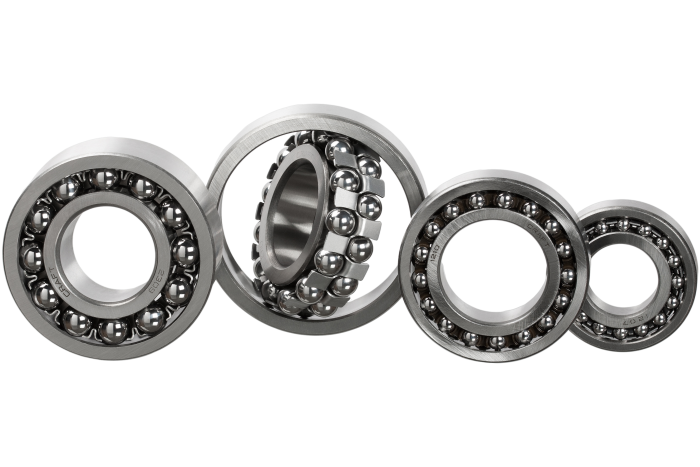
- Self-Aligning Ball Bearings:
Self-aligning ball bearings consist of an inner ring with two rows of balls and an outer ring with a spherical raceway. The design allows for misalignment compensation and is particularly suited for applications with low to moderate radial loads and moderate axial loads. Self-aligning ball bearings are commonly used in electric motors, pumps, and automotive applications.
- Self-Aligning Thrust Roller Bearings:
Self-aligning thrust roller bearings are designed to accommodate misalignment in applications with axial loads. They have a spherical rolling element between the shaft washer and the housing washer, allowing for misalignment compensation. These bearings are commonly used in applications such as screw conveyors, heavy machinery, and marine propulsion systems.
- Adapter Sleeve Bearings:
Adapter sleeve bearings are a type of self-aligning bearing that incorporates an adapter sleeve, which facilitates easy mounting and dismounting of the bearing. They are commonly used in applications where frequent bearing replacement or adjustment is required. Adapter sleeve bearings are often employed in conveyor systems, agricultural machinery, and textile equipment.
These are just a few examples of common types of self-aligning bearings. Other variations and specialized designs exist to suit specific application requirements. It’s important to consider factors such as load capacity, operating conditions, and dimensional constraints when selecting the appropriate self-aligning bearing for a particular application.


editor by CX 2023-11-13