Application
Spherical Plain Bearings for Wind Energy
Wind-energy linkages often move slowly and are difficult to service, so maintenance strategy, temperature, moisture and articulation pattern deserve early attention.

Application Overview
What changes the bearing decision
Wind-energy equipment uses spherical plain bearings in selected pitch, yaw-assist, hydraulic and service mechanisms where angular movement must be accommodated within a compact joint. Motion is often slow and repetitive rather than continuous rotation, while maintenance access can be limited after installation.
Onshore and offshore environments place different demands on the surrounding joint. Moisture, salt exposure, temperature range, seal life and planned inspection interval need to be described before the sliding system is selected. Maintenance-free PTFE-lined families are attractive where routine greasing is difficult, but the actual load, articulation amplitude and liner temperature still need review. For protected and serviceable joints, a conventional greaseable GE or GEG construction may remain the more suitable route.

Key Application Points
Where spherical plain bearings are used
Pitch / yaw auxiliary linkages
Slow oscillation and difficult service access can make maintenance-free GE..C or GE..ET 2RS families worth comparing.
Hydraulic actuator eyes
Load and available width determine whether GE or wider GEG constructions are appropriate.
Service mechanisms
Protected low-speed pivots may favor maintenance-free liners when the planned maintenance strategy avoids routine greasing.
Recommended Products
EVER POWER series to compare first
Sealed PTFE-fabric route for slow oscillation and service conditions where reduced routine maintenance is important.
Maintenance-free PTFE-composite family for protected pivots where the open liner construction matches the environment.
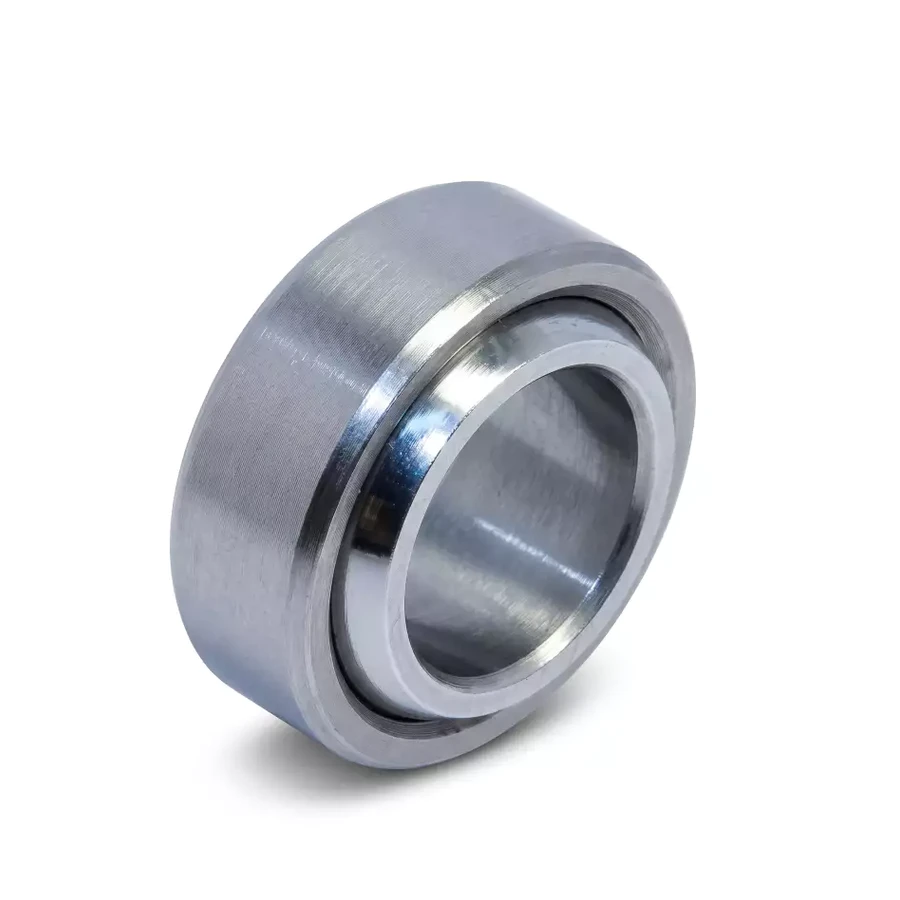
Serviceable wider GEG route for higher-load joints with deliberate lubrication access.
選択ガイド
Inputs that matter before model selection
Cycle and articulation
State the angular movement and cycle pattern; a low-speed joint can still concentrate load in a narrow contact zone.
Temperature range
Liner and seal behavior depends on the operating temperature, so the site-specific temperature range belongs in the RFQ.
Corrosion exposure
Separate sheltered humidity from salt spray, wash-down or offshore exposure because the corrosion strategy may change.
Maintenance interval
Choose a maintenance-free route only when the surrounding joint and inspection plan are consistent with that strategy.
Technical Challenges
Common problems and the practical selection response
Long service intervals
PTFE-lined maintenance-free families can reduce routine grease work where the application conditions support them.
Moisture and offshore exposure
Seals protect bearing faces but do not replace a complete corrosion strategy for the pin, housing and adjacent materials.
Low-frequency concentrated motion
Inspect contact surfaces and clearance growth because low total revolutions do not eliminate localized wear.
Related Technical Articles
Continue the selection work
Maintenance-Free Bearings for Wind-Energy Linkages
Why low-speed articulated joints often focus on maintenance strategy and liner construction.
GE..C vs GE..ET 2RS
Compare two maintenance-free constructions and the role of face sealing.
How to Select a Spherical Plain Bearing
A six-step route through load, motion, maintenance and environment.
Discuss your wind-energy bearing requirements
Send the current bearing marking, d / D / B / C dimensions, joint location, motion, contamination, maintenance access and any drawing or document requirement.