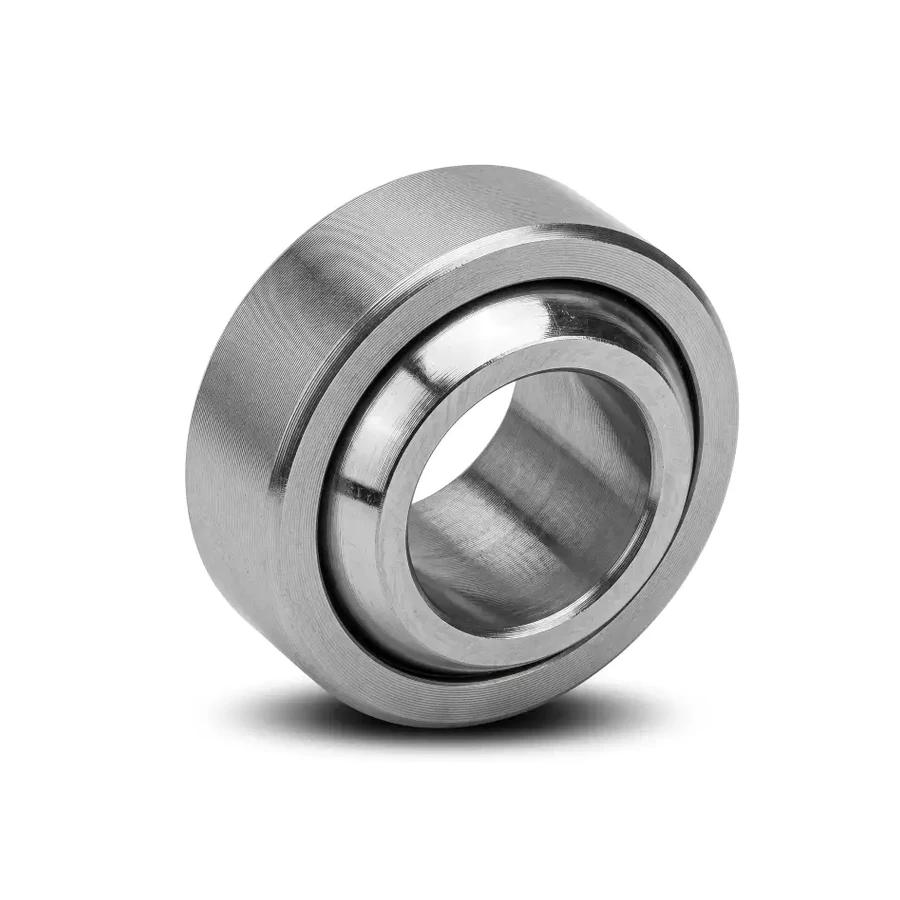
Rod-end bearings and spherical plain bearings use the same basic spherical-joint idea, but they are not the same component. A spherical plain bearing is the bearing element that fits into a housing. A rod end packages a spherical bearing into a body with an internal or external threaded connection.
What is a rod-end bearing?
A rod end combines a spherical bearing head with a threaded shank or threaded body so it can connect directly to a link. This makes rod ends useful when linkage length must be adjusted or when the machine does not have a separate pressed bearing housing. EVER POWER groups GIF, GAR and related designations in the rod-end reference hub.
What is a standalone spherical plain bearing?
The GE, GEG, C, ET and PB families are standalone bearing elements. The machine designer controls the housing, shoulder, pin and retention method. This gives more flexibility for heavy-duty pivots and larger bores, but it also puts more responsibility on the surrounding structure.
Structural comparison
| Feature | Rod end | Spherical plain bearing |
|---|---|---|
| Housing | Integrated rod-end body | Separate machine housing required |
| Connection | Threaded linkage | Pressed or retained in a bore |
| Length adjustment | Often possible through thread position | Handled by surrounding machine design |
| Best use | Adjustable or compact linkage end | Dedicated pivot housing, often higher structural freedom |
| Replacement check | Thread, hand, shank and bearing insert | d / D / B / C, fit and joint geometry |
When a rod end is usually preferred
- Link length or alignment needs threaded adjustment.
- The connection point does not have a separate bearing housing.
- The assembly is intended to be replaced as one threaded joint component.
When a spherical plain bearing is usually preferred
- The machine already has a dedicated bearing housing or clevis.
- The joint is large or heavily loaded and the surrounding structure can be designed around the bearing.
- The designer needs direct control over the housing, shoulders and pin retention.
EVER POWER rod-end references
The current site keeps GIF/GIR/GAR/GIL and related rod-end designations in a reference hub because the same model-level dimensional coverage is not available for every rod-end family. Send the full thread and housing requirements if the enquiry is for a rod end rather than a standalone insert.
Thread geometry is part of rod-end selection
With a rod end, the bearing insert can be correct while the assembly is still wrong because the thread size, thread direction, shank length or housing width does not match the linkage. Record whether the old part uses male or female threads and right-hand or left-hand adjustment. These details are outside the standalone spherical bearing model code.
Load path through the threaded body
A rod end transfers load through its threaded housing, so bending at the shank and mounting geometry can influence capacity. A standalone spherical plain bearing transfers load into a separate machine housing, giving the designer more freedom to make the structure wide and stiff. That is why the two products cannot be compared only by the spherical insert diameter.
Replacement checklist for rod ends
- Thread diameter, pitch and hand.
- Male or female housing form.
- Centre height and overall length.
- Spherical bore and articulation.
- Seal/liner construction.
- Load direction and any bending on the shank.
Cross-reference caution
Rod-end brand tables can translate family names, but the thread and housing dimensions must be verified separately. Use the EVER POWER rod-end reference hub to identify the family, then send the old drawing or measurements for model-level confirmation.
Not sure whether the old part is a rod end or a bearing insert?
Send a photo, the marking, thread details and the joint drawing so the product family can be separated before quotation.