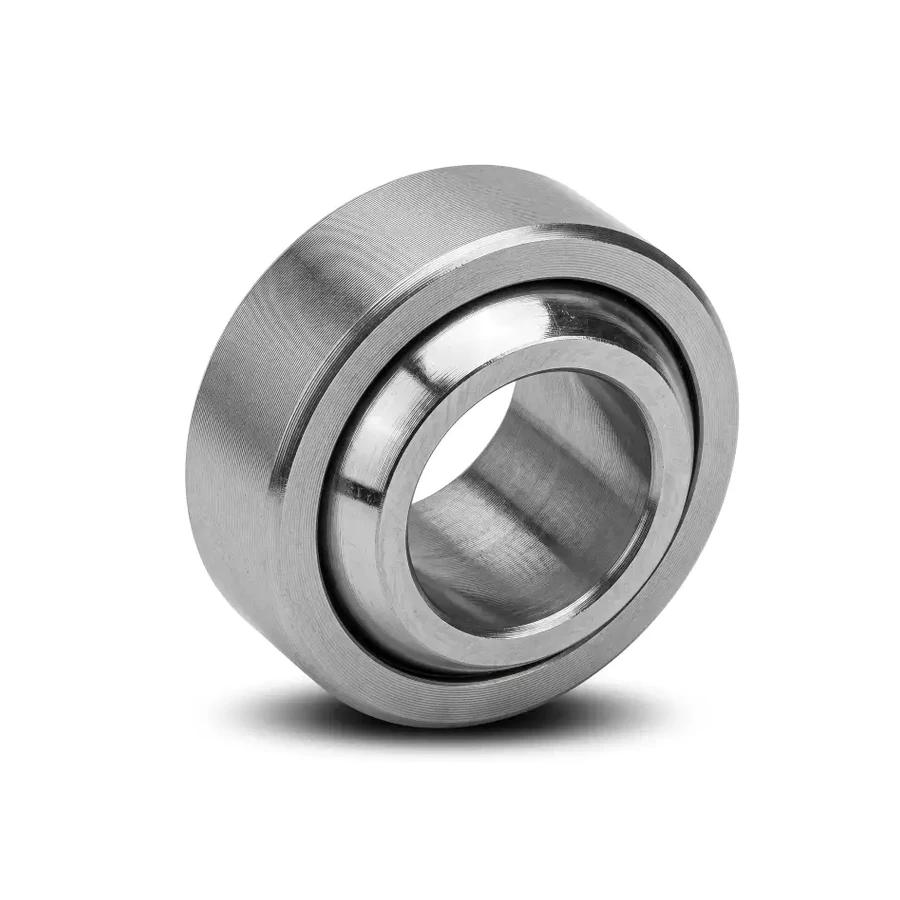
Phosphate treatment is common on steel spherical plain bearing rings because it improves the way the surface holds lubricant and provides a useful conversion layer for ordinary corrosion protection. In the EVER POWER steel/steel product pages, phosphate-treated outer and inner rings are part of the published construction description.
What is phosphate treatment?
Phosphating is a chemical conversion process that creates a fine crystalline phosphate layer on a steel surface. The layer is not a thick structural coating; its value comes from surface conditioning, oil or grease retention and improved resistance to light corrosion when used with the rest of the protection system.
Benefits in a spherical plain bearing
- Lubricant retention: the microtexture helps retain grease during running-in and service.
- Running-in behavior: the treated surface can reduce direct metal scuffing while the lubricated sliding pair settles.
- Corrosion support: it provides more protection than bare steel when combined with grease, oil or appropriate storage protection.
- Surface preparation: phosphated steel can also provide a useful base for some additional protective systems.
Phosphate vs other surface treatments
Black oxide, hard chrome, nickel-based coatings and stainless materials solve different problems. A hard, wear-resistant chrome surface is not equivalent to a porous phosphate conversion layer, and a corrosion-resistant alloy is not simply a thicker phosphate coating. Choose the system from wear, corrosion, liner and cost requirements.
Where phosphate treatment is used in the current range
The standard steel/steel GE and GEG product pages describe phosphate-treated rings, while PTFE-lined families emphasize the liner and chromium-plated spherical inner-ring surface. Read the exact series construction because surface treatment changes with the sliding system.
Limitations
Phosphate treatment should not be treated as stand-alone protection for continuous salt water, aggressive chemicals or another severe corrosion environment. In those cases, the joint may need special materials, coatings, sealing and maintenance procedures.
How phosphate treatment works with grease
The crystalline conversion layer has a microtexture that can retain lubricant. During early sliding, that reservoir helps maintain a lubricated interface on steel/steel bearings. It is not a substitute for the grease system; without lubricant and appropriate storage protection, the phosphate layer alone has limited corrosion capability.
Appearance is not a complete quality test
Phosphated parts often have a dark grey or black appearance, but colour alone does not prove coating weight, uniformity or process quality. If phosphate treatment is contractually important, define the required process or inspection rather than judging only from a product photo.
Interaction with other surfaces
The spherical inner-ring surface may have a different finish or coating from the rest of the ring, especially in maintenance-free families. That is why a buyer should read the construction by series. A process appropriate to the outer ring may not be the sliding surface treatment used on a PTFE-lined bearing.
Where special corrosion protection starts
- Continuous salt-water or chemical exposure.
- Aggressive wash-down fluids.
- Very long unprotected storage.
- Galvanic combinations with surrounding materials.
- Customer specifications that explicitly require a different coating or alloy.
Need a surface-treatment requirement reviewed?
Send the environment, existing bearing code and any coating/material specification with the RFQ.