Application
Spherical Plain Bearings for Railway & Transportation
Rail and transport linkages combine vibration, repeated oscillation and long maintenance intervals, so the maintained drawing and joint condition matter as much as the family code.

Application Overview
What changes the bearing decision
Rail and transport equipment use spherical plain bearings in suspension links, brake mechanisms, tilting systems and other articulated connections that combine vibration with repeated oscillation. Maintenance intervals can be long, and replacement work often has to follow a controlled drawing or maintenance record rather than a generic bearing family alone.
The joint should be reviewed for load direction, shock, temperature, contamination and accessibility. Heavy-duty GEG families are relevant where section width and load path justify them; maintenance-free GE..C can be useful when service access is limited; sealed GE..ES 2RS can help compact joints exposed to contamination. The exact replacement still needs the maintained equipment specification and the physical dimensions of the joint.

Key Application Points
Where spherical plain bearings are used
Bogie and suspension linkages
Heavy-duty GEG bearings are a comparison route where wider joint geometry and repeated shock are present.
Brake / actuator mechanisms
Compact GE or maintenance-free families may be relevant depending on service access and contamination.
Tilting or articulated transport systems
Angular motion, vibration and inspection interval should be defined before choosing the sliding system.
Recommended Products
EVER POWER series to compare first
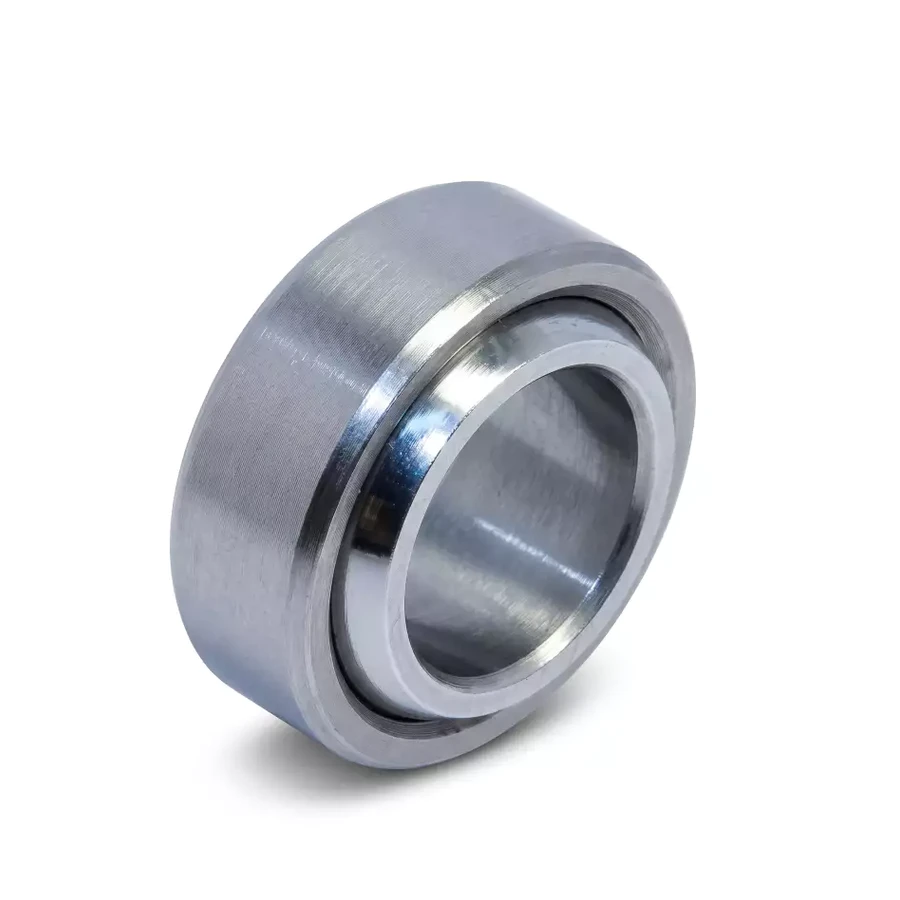
Wider serviceable family for heavily loaded articulated links when periodic lubrication is part of the maintenance plan.

Maintenance-free PTFE-lined option for protected joints with limited grease access.
Compact sealed route for contaminated pivots that still use a greaseable construction.
Selection Guide
Inputs that matter before model selection
Drawing revision
Confirm the maintained equipment drawing or replacement specification rather than relying only on the removed bearing code.
Vibration and shock
Include the direction and severity of repeated loads because edge loading can accelerate wear.
Temperature and environment
State ambient and operating temperature plus contamination or water exposure at the joint.
Inspection interval
Maintenance-free and sealed constructions should be evaluated together with the planned inspection and replacement schedule.
Technical Challenges
Common problems and the practical selection response
Traceable replacement records
Keep the bearing designation, dimensions and equipment drawing revision aligned so future maintenance can identify the installed part.
Long service intervals
A maintenance-free route may reduce greasing needs, but inspection of clearance, seals and adjacent pins remains necessary.
Vibration-driven wear
Check fretting in the housing and pin condition during replacement instead of focusing only on bearing clearance.
Related Technical Articles
Continue the selection work
How to Select a Spherical Plain Bearing
A practical framework for load, motion, environment and interface selection.
Fitting Tolerances
Read bore and shaft tolerance classes before defining the final fit.
Five Failure Patterns to Investigate
Common wear patterns that point to housing, pin or lubrication problems.
Discuss your railway or transportation bearing requirements
Send the current bearing marking, d / D / B / C dimensions, joint location, motion, contamination, maintenance access and any drawing or document requirement.